

Horizontal Drilling That Supports the Whole Network, Not Just the Bore
As broadband demand surges across Colorado and the Mountain West, network owners need more than just a good bore crew — they need construction partners who deliver complete, high-performance infrastructure. At Trace Fiber Services, horizontal directional drilling (HDD) is one of several in-house capabilities (including plowing & aerial installation) we use to ensure projects move safely, efficiently, and on schedule.
Unlike subcontracted drillers focused only on footage, we view every bore in the context of a full network lifecycle — from permitting and engineering through splicing, restoration, and turnover.
What Is HDD — and Why It Matters in Telecom in Colorado
Horizontal directional drilling is a trenchless installation method that allows conduit to be placed beneath roads, driveways, railroads, waterways, and other surface features without open trenching. Horizontal drills use a steerable drill head, combined with pressurized water and mud mixtures to create “bores.” Using HDD equipment, our teams can create precise underground paths – pulling conduit or stick pipe back through the bore hole once the path is cleared and conditioned. This process is essential for Colorado telecom network construction.
How does a Horizontal Directional Drill Work
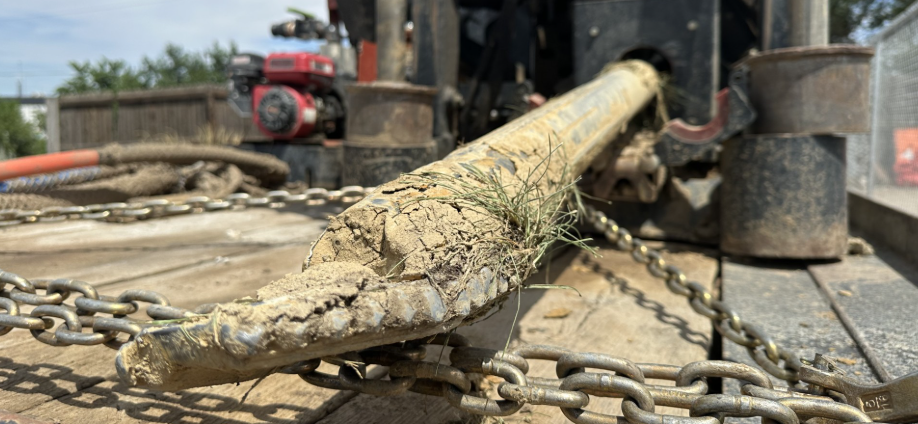
A directional drill works by using spinning, applying pressure, and pumping drill fluid through the drill bit. Like any drill, the spinning action of the drill allows the drill bit (usually a paddle bit) to twist through dirt and soil. Behind the bit, the HDD unit pushes through 10 foot rods to drive the bit forward. Finally, pressurized drilling fluid helps break up and flush the cut soil.
As the drill progresses forward, the drill adds rods to continue to push while the drilling fluid creates a barrier around the horizontal hole.
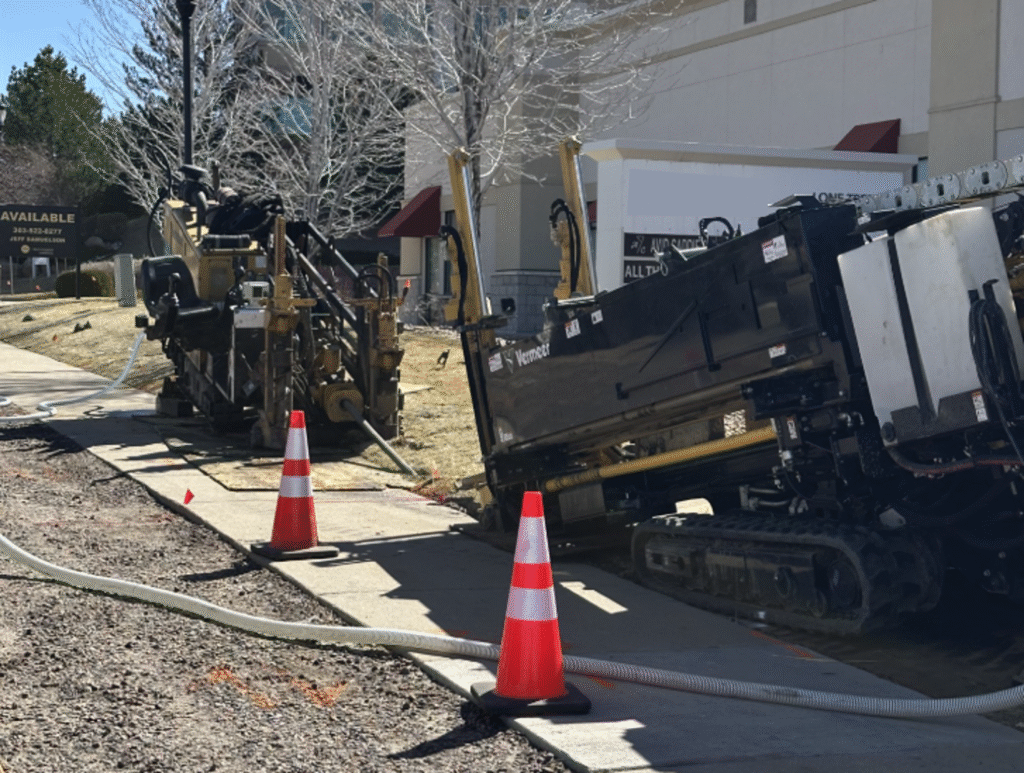
HDD drills are just one part of a larger team. Drill teams include mud mixing systems, hydrovac trailers, prime movers (trucks), and traffic control. In some situations, mini-excavators or water reclaimers may also be part of the drilling team.
What companies make HDD units?
There are a few companies that make excellent drills. Trace crews primarily utilize Vermeer drills (like the D23x30 and D20x22) as well as Ditch Witch (such as the JT-20). While each company produces proprietary features on their drills, the general functions are quite similar.
But successful HDD isn’t just about putting pipe in the ground — it’s about getting the right alignment, depth, and clearance to ensure network longevity, minimize utility conflicts, and comply with jurisdictional and environmental requirements.
Where HDD Fits into Trace Fiber’s Full-Stack Construction Model
Trace uses HDD strategically across a variety of build scenarios, including:
-
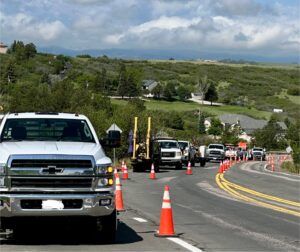
Urban corridors with tight rights-of-way: HDD allows us to minimize surface disruption, protect existing utilities, and limit restoration costs. This is especially important for network relocations.
-
Highway or railroad crossings: We handle complex drills beneath state-maintained infrastructure, often avoiding lengthy lane closures or detours.
-
Rural backbone builds: Long-distance bores under ditches, culverts, and seasonal creek beds accelerate timelines while maintaining environmental compliance.
Because we manage the entire scope — from traffic control & permitting to final splice & test — our use of directional drills is always aligned with the broader network project plan.
What Sets Trace’s Colorado HDD Delivery Apart
We’re not just a drill subcontractor. We’re a turn-key telecom general contractor with in-house HDD crews, civil crews, splicers, project managers, and back-office support — all working from a shared operational platform.
Here’s what that means in the field:
-
Locates and potholing are handled early and accurately — we don’t rely on vague paint marks to guess drill paths.
-
Permitting, traffic control, and restoration are integrated and scheduled in-house.
-
Utility avoidance is actively managed by experienced drill crew leads, with oversight from our in-house project managers.
-
Drill paths align with OSP design requirements — not just what’s fastest for the rig.
- Seamless handoff to post-construction crews for fiber installation and splicing
-
Issues get resolved fast because there’s no finger-pointing between trades or vendors.
Every project is tracked in Monday, just like every other step in the construction lifecycle — ensuring real-time visibility and accountability.
Why Siloed HDD Crews Create Risk
Standalone HDD subcontractors may complete the bore, but often lack context for the overall network build. That can lead to:
-
Improper depths or deflection that complicate future splicing.
-
Missed restoration standards that violate permits or local agreements.
-
Poor documentation required for as-builts (red lines) or customer turnover.
-
Rework or delay due to misaligned sequencing with other crews.
By contrast, Trace Fiber manages engineering, drilling, civil, splicing, restoration, and acceptance as one continuous workflow — reducing risk and improving total delivery time.
Ready to Build Smarter, Safer Fiber?
Horizontal directional drilling is a powerful tool for network construction — but only when used as part of a larger project plan. At Trace Fiber Services, we combine HDD with engineering insight, construction experience, and schedule discipline to deliver fiber networks built to perform and built to last.
Need a partner who drills with purpose?
Contact us to scope your next underground fiber project.