
At Trace Fiber Services, fiber optic cable installation isn’t an afterthought — it’s a core capability. For many Colorado underground contractors, the job stops at the bore. But for us, it continues until the final ribbon is spliced, tested, documented in red lines, and ready for customer activation. That full-scope approach sets Trace apart across Denver and the Colorado Front Range.
We don’t just drill and hand it off — we build the complete path from permit to punch list.
Fiber optic cable installation methods
Installing the actual fiber optic cable is one of the most critical phases of a telecom construction project. How that cable is placed — whether blown, pulled, or prepped with mule tape — directly impacts signal performance, future serviceability, and emergency restoration response.
Fiber Blowing (Jetting): Speed and Efficiency (in the right conditions)
When the conduit system is clean, dry, and straight, blowing (also called fiber jetting) allows our teams to install long runs of fiber with minimal handling. Using compressed air and a fiber blowing unit, the cable is propelled through the innerduct on a cushion that reduces friction and eliminates stress on the glass.
This technique is ideal for new construction, long haul, and high-count ribbon applications. It reduces splice points, improves long-term network performance, and gets us to testing faster — especially when time-to-light is critical. Fiber jetting can be difficult when there is minimal space between the duct ID and cable OD, as well as in situations where there are many bends in the conduit.
Mule Tape: Small Detail, Critical to Cable Installation
As part of our OSP network construction (and per most SOWs), Trace crews pull mule tape into new conduits after trenching or HDD boring is complete. This low-friction, high-strength pull tape is used for future cable installations. While there are many configurations of mule tape, we prefer to use 2,500 lb tensile strength mule tape for larger cable installations (like an 864F). Some Mule Tape is also locatable, which can help prior to the installation of tracer wire.
Mule tape can be installed in a number of ways. Some crews use the vacuum capability of their 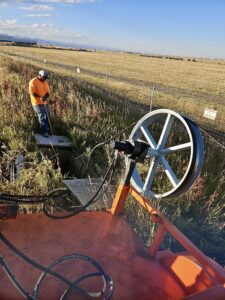 , while others use an industrial compressor to blow the tape in. In some cases, a rodder may be used to install tape.
Mechanical Pulling: Reliable in Complex Conditions
Jetting isn’t always possible, especially in congested urban corridors or legacy duct banks. That’s where mechanical pulling is the right tool. Our crews use tension-monitored winches to pull cable safely through conduit, maintaining bend radius and minimizing strain.
Because pulling introduces more variables, it requires experienced hands. Pre-lubrication, pull calculations, and real-time monitoring ensure the cable arrives undamaged and ready to splice. This is a standard part of our fiber installation playbook across the Front Range.
Though modern advances in fiber strands are quite durable, they are susceptible to radius breakage, as well as over pulling (too high pull strength). These variables very much depend on the specific cable specs, as well environmental conditions.
Fiber installation situations
Fiber Installation: Protection for Now and Later
Properly installed fiber needs more than just a path — it needs protection. That includes environmental insulation to guard against moisture, temperature swings, and rodent intrusion. This matters not only for long-term performance. Rapid fiber installation can also be a critical part of the emergency restoration after a damage.
When a line is cut or compromised, rapid installation of a new cable can be a critical step when adding a splice case isn’t optimal. Our crews often work overnight to restore service — and the quality of the original installation directly affects how fast we can respond.
Trace: A True End-to-End Telecom Partner
In many parts of Colorado, especially along the fast-growing Front Range, telecom infrastructure is being built under tight timelines and even tighter budgets. Too often, contractors complete the bore, drop in a conduit, and leave the customer to coordinate the rest. That’s not how we operate.
At Trace, fiber installation is baked into the project from day one. Our teams coordinate drilling, conduit proofing, mule tape placement, fiber jetting or pulling, and splicing as one integrated flow. That means better communication, fewer delays, and one team responsible for delivery.
We’re not just a drill crew. We’re a fiber crew.
If you need help with cable installation or a full scope construction process, contact our estimating team.