
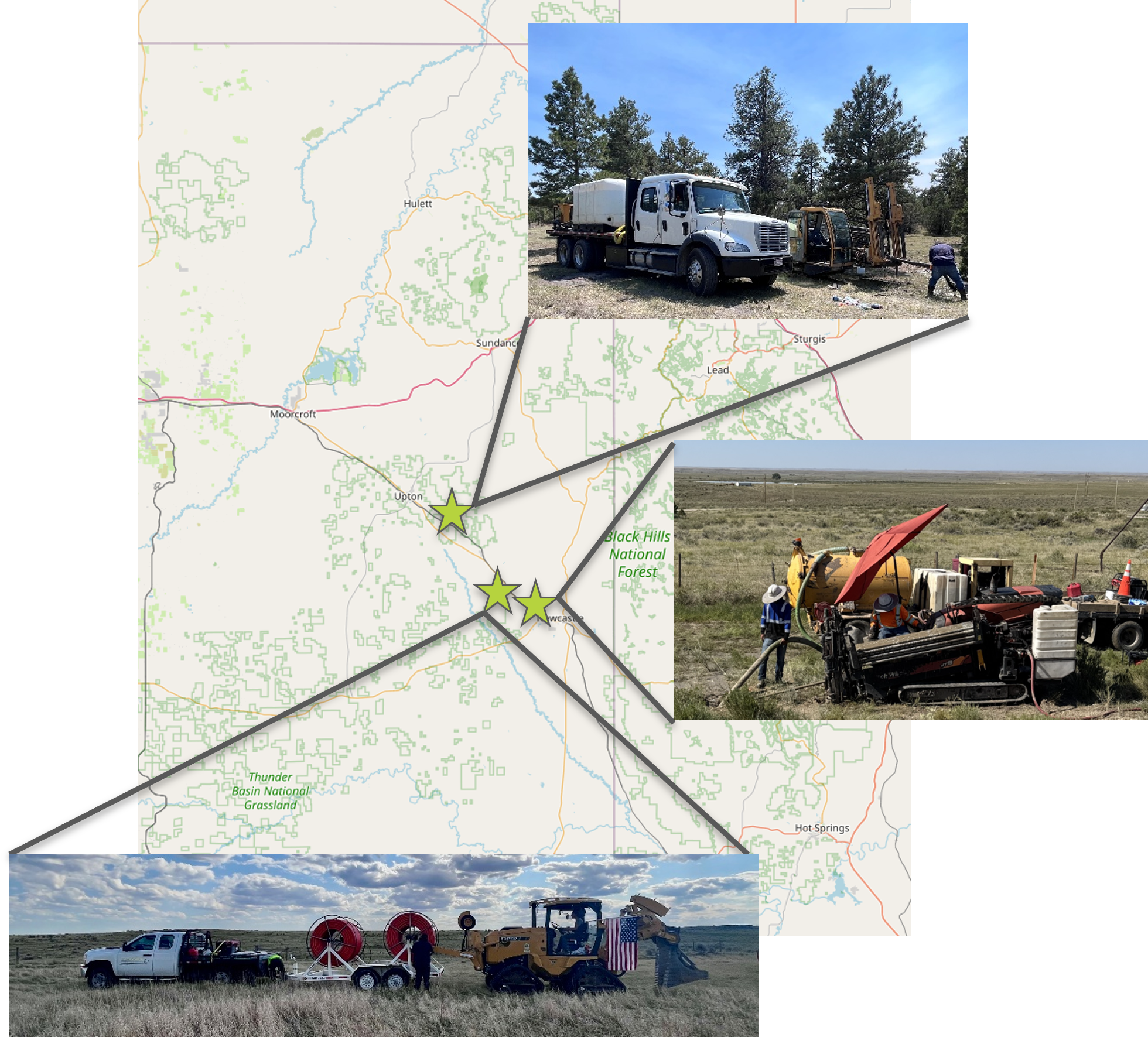
Rural broadband projects demand more than a single construction specialty. They require multiple crews working together across long stretches of open terrain, complex

utility crossings, and small communities—all while keeping production moving.
On a recent middle-mile fiber project near Osage, Wyoming, Trace Fiber Services provided exactly that: a single contractor capable of handling every major phase of outside plant construction.
By combining plow crews, directional drilling teams, and in-town construction crews under one project team, we helped keep installation moving efficiently from open countryside into the communities the network will ultimately serve.
Building the Backbone Between Rural Communities
Much of the project consisted of long middle-mile fiber routes connecting communities across northeastern Wyoming.
These stretches are ideal for high-production plowing, allowing large sections of conduit to be installed efficiently while minimizing disturbance to surrounding land.
Rather than coordinating multiple contractors for different phases of work, the project relied on Trace crews to manage installation across the entire corridor, simplifying scheduling, communication, and project management.

Stitching the Network Together
Not every section of a rural fiber route can be plowed.
Roadways, existing utilities, drainage features, and other obstacles require directional drilling to maintain a continuous conduit path without open-cut construction.
Our larger drill crews completed these critical bore crossings throughout the project, effectively stitching together the long plowed sections into one continuous fiber route.
By self-performing both plowing and larger directional drilling operations, Trace was able to coordinate crews, adjust schedules quickly, and keep construction progressing without unnecessary delays between contractors.
Bringing Fiber Into Town
As the backbone route reached smaller Wyoming communities, the construction approach changed.
Instead of long production plow runs, our smaller directional drill crews installed conduit through town, placed underground vaults, and completed the detailed work needed to prepare the network for future distribution.
These installations required greater precision while working around existing utilities, roadways, and local infrastructure—demonstrating the flexibility to transition from large-scale rural construction to more intricate municipal work.

One Contractor. Multiple Disciplines.
Projects like this highlight one of Trace Fiber Services’ greatest strengths: the ability to deliver multiple construction methods with one coordinated team.
Rather than managing separate contractors for rural plowing, directional drilling, and community infrastructure, project owners benefit from:
- Simplified project management
- Consistent construction quality
- Better coordination between crews
- Faster schedule adjustments
- Greater accountability from start to finish
For long-haul and middle-mile fiber projects, that integrated approach helps keep construction moving while reducing complexity for customers.
Building Rural Connectivity
Expanding broadband access across rural communities takes more than equipment—it takes experienced crews that understand how different construction methods work together. It takes a contractor that has all of the crew times in-house, experienced project managers, financial stability, and regional experience.
From high-production plowing across open terrain to complex directional bores and precision work inside small towns, the Osage project demonstrates how Trace Fiber Services delivers complete fiber construction solutions under one roof.
As broadband infrastructure continues expanding across the Mountain West, we’re proud to help build the networks that connect rural communities today while supporting future growth tomorrow.
Need help on a project? Reach out to our team.