
As AI workloads continue to grow and data center campuses expand, fiber infrastructure is being pushed farther than ever before. Modern backbone networks routinely span dozens—or even hundreds—of miles between facilities. Whether you’re connecting hyperscale data centers, carrier hotels, edge computing sites, or regional Points of Presence (PoPs), the performance of every fiber strand matters.
Unlike enterprise LAN testing, Ultra Long Haul (ULH) fiber testing presents unique challenges. Distances exceeding 50 miles require specialized test procedures, higher-powered equipment, and experienced technicians who understand how to interpret results over extended fiber spans.
Unlike enterprise fiber, where a few tenths of a decibel may have little operational impact, long-haul transport systems are engineered around carefully calculated optical budgets. Every splice, connector, and mile of fiber contributes to the total attenuation, making accurate acceptance testing essential before optical equipment is commissioned.
For organizations investing millions in network infrastructure, comprehensive ULH testing helps ensure the network performs as designed before it begins carrying mission-critical traffic.
What Is Ultra Long Haul Fiber Testing?
Ultra Long Haul fiber testing refers to the certification and characterization of optical fiber links extending well beyond traditional enterprise distances. While there is no universal definition, the term is commonly used for fiber spans exceeding 80 km (50 miles).
These networks commonly connect:
- Regional and long-haul telecommunications infrastructure
- Hyperscale and enterprise data centers
- AI computing clusters
- Internet exchange points (IXPs)
- Utility communications networks
- Government and research facilities
Because optical loss accumulates over distance, even minor construction defects, poor splices, dirty connectors, or fiber bends can significantly impact overall network performance.
Why ULH Testing Matters
Data Centers
Today’s data centers rarely operate in isolation. Disaster recovery sites, secondary campuses, and geographically distributed AI clusters depend on reliable long-distance fiber.
Operators need confidence that every fiber pair meets the optical budget required for modern optics, including 100G, 400G, and increasingly 800G Ethernet.
Finding excessive loss after equipment has been deployed is significantly more expensive than identifying issues during acceptance testing.
Telecommunications Providers
Carrier backbone networks often span hundreds of miles while passing through numerous splice locations, handholes, switching offices, and amplification sites.
ULH testing verifies:
- End-to-end attenuation
- Splice quality
- Connector performance
- Fiber continuity
- Accurate route documentation
This information becomes the baseline for future maintenance, troubleshooting, and restoration efforts.
AI Infrastructure
Large AI deployments generate enormous amounts of east-west traffic between GPU clusters, storage systems, and geographically distributed compute environments.
Although the optics themselves largely determine latency, excessive optical loss reduces available system margin and can affect long-term reliability. Thorough fiber testing helps ensure the transport infrastructure is ready before these high-performance systems are placed into production.
Colorado’s Role in Long-Haul Fiber Networks
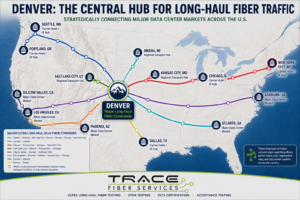
Colorado has become an increasingly important crossroads for long-haul telecommunications infrastructure across the western United States. Denver’s central location makes it a natural aggregation point for traffic moving between the West Coast, Texas, the Midwest, and the Mountain West.
Many national carriers maintain major switching facilities and transport hubs throughout the Denver metropolitan area, with backbone routes extending north toward Wyoming, east into Nebraska and Kansas, south through Colorado Springs into New Mexico, and west across the Rockies toward Utah and the Pacific Northwest.
As cloud providers, hyperscale data centers, AI infrastructure, and regional carriers continue investing in Colorado, the demand for professional long-haul fiber testing continues to grow.
Unlike enterprise networks, these backbone routes transport enormous volumes of traffic between critical network elements.
Typical ULH testing is performed between:
- Carrier switching offices
- Intermediate Line Amplifier (ILA) sites
- Optical regeneration or retransmission facilities
- Regional Points of Presence (PoPs)
- Long-haul transport shelters
- Data center interconnection facilities
Each segment must be tested and documented before traffic is placed into service to verify that every portion of the transport network performs within its engineered optical budget.
The ULH Fiber Testing Process
Successful ULH testing involves much more than connecting a test instrument and recording a pass or fail.
1. Network Review
Technicians begin by reviewing route drawings, splice documentation, fiber counts, and engineered loss budgets.
2. Connector Inspection and Cleaning
Every connector is inspected and cleaned before testing begins. Even microscopic contamination can create measurable loss over long distances.
3. Optical Loss Testing (OLTS)
An Optical Loss Test Set (OLTS) measures total end-to-end insertion loss.
For ULH applications, the OLTS must provide sufficient dynamic range to accurately certify fiber spans extending well beyond traditional enterprise distances. Trace generally conducts this testing with Exfo 945s or the newer Exfo 975.
4. OTDR Testing
An Optical Time Domain Reflectometer (OTDR) provides a detailed picture of the entire fiber route.
Rather than measuring only total loss, an OTDR identifies individual events throughout the link, including:
- Splice loss
- Connector reflections
- Fiber bends
- Breaks
- Overall fiber length
Long-haul OTDR testing requires significantly greater dynamic range and longer pulse widths than enterprise testing.
For carrier backbone networks, testing is typically performed in both directions. Bidirectional OTDR testing compensates for differences in backscatter and splice geometry, producing a more accurate calculation of true splice loss and creating a reliable baseline for future maintenance.
5. Testing Beyond Standard Wavelengths
Most acceptance testing is performed at 1310 nm and 1550 nm.
Many long-haul providers also utilize 1650 nm OTDR testing, particularly during maintenance and troubleshooting of existing transport networks.
One of the primary advantages of 1650 nm testing is that it allows technicians to evaluate fibers within an active cable without disrupting production traffic, provided the network utilizes the appropriate WDM filters. This enables maintenance testing while critical services remain online.
Testing at 1650 nm is also more sensitive to macro-bends and micro-bends, helping technicians identify developing issues that may not be readily apparent at lower wavelengths. Not all OTDRs test at 1650, so the testing organization generally needs a more modern OTDR (such as an Exfo FTB-2 with the right card).
6. Documentation
Professional ULH testing concludes with comprehensive documentation that includes:
- OTDR traces
- OLTS certification reports
- Fiber lengths
- Event tables
- Optical loss measurements
- Pass/fail criteria
- Test wavelengths and conditions
This documentation provides a valuable baseline for future troubleshooting and maintenance.
Equipment Matters
Not every fiber test platform is designed for Ultra Long Haul applications.
Testing fiber routes exceeding 50 miles requires equipment capable of maintaining accuracy across extended optical distances.
Long-Range OTDRs
Professional ULH OTDRs provide:
- High dynamic range
- Long-distance pulse capabilities
- Multiple testing wavelengths
- High-resolution event analysis
- Comprehensive reporting
High Dynamic Range OLTS Platforms
Professional OLTS systems verify total insertion loss using stabilized light sources and calibrated power meters capable of accurately measuring extended fiber spans.
Why Experience Matters
Owning advanced test equipment is only part of the equation.
Long-haul routes may include dozens—or even hundreds—of splice enclosures, multiple ILA sites, regeneration facilities, and switching locations before reaching their destination.
Experienced technicians understand optical loss budgets, bidirectional OTDR analysis, launch and receive fibers, dead zones, standards-based certification procedures, and how to distinguish expected optical events from conditions requiring corrective action.
Accurate interpretation is just as important as accurate measurement.
Supporting Colorado’s Expanding Fiber Infrastructure
Colorado continues to experience significant investment in telecommunications infrastructure, hyperscale data centers, AI computing, and regional transport networks. As these backbone systems grow, acceptance testing becomes increasingly important to ensure newly constructed fiber performs as engineered before production traffic is introduced.
At Trace Fiber Services, we support telecommunications providers, utilities, enterprise organizations, and data center operators with professional Ultra Long Haul (ULH) fiber testing throughout Colorado and the surrounding region. Our technicians perform comprehensive OTDR and OLTS testing, including bidirectional OTDR analysis and long-wavelength testing where appropriate, delivering the documentation needed to commission backbone fiber between switching facilities, ILA sites, regeneration facilities, and data centers with confidence.
Ready to Validate Your Long-Haul Fiber Network?
Whether you’re commissioning a new backbone route, connecting data centers, or expanding AI infrastructure, comprehensive ULH testing helps ensure your network performs as designed from day one.
Contact Trace Fiber Services today to learn how our experienced technicians and advanced fiber testing capabilities can support your next long-haul fiber deployment.