
Across Colorado, network expansion is accelerating. From growing suburbs along the Front Range to mountain communities investing in broadband resilience, fiber construction is happening everywhere. But for network owners planning new builds, one challenge continues to slow deployments: municipal permitting delays.
Cities like Denver, Colorado Springs, Aurora, and Lakewood all have unique processes for right-of-way permits, traffic control plans, inspections, and bonding. When contractors rely on third parties or wait until construction is about to begin to handle permitting, projects can stall for weeks (or even months).
That’s why many network owners are shifting toward turn-key contractors who manage permitting and bonding in-house. In Colorado’s increasingly complex regulatory environment, that capability can be the difference between a project that stays on schedule and one that drifts into the next construction season.
Why Permitting Delays Are Increasing Across Colorado
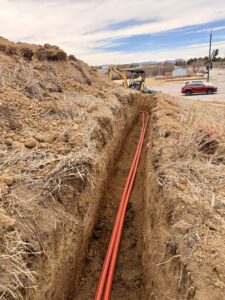
Municipalities across the state are seeing more infrastructure activity than ever before. Broadband expansion, utility upgrades, transportation improvements, and private development are all competing for the same right-of-way space.
Several factors are contributing to longer permitting timelines:
1. Increased infrastructure demand: Cities along the Front Range are experiencing rapid growth. As a result, permitting departments are handling a higher volume of applications for street cuts, trenching, and conduit installation.
2. Complex right-of-way regulations: Each Colorado municipality has its own requirements for traffic control, restoration standards, inspections, and bonding. What works in Longmont may not be approved in Colorado Springs.
3. Seasonal construction pressure: In Colorado, weather compresses construction schedules. Many fiber builds happen between late spring through early fall, which means permitting departments experience seasonal application surges prior and during those months.
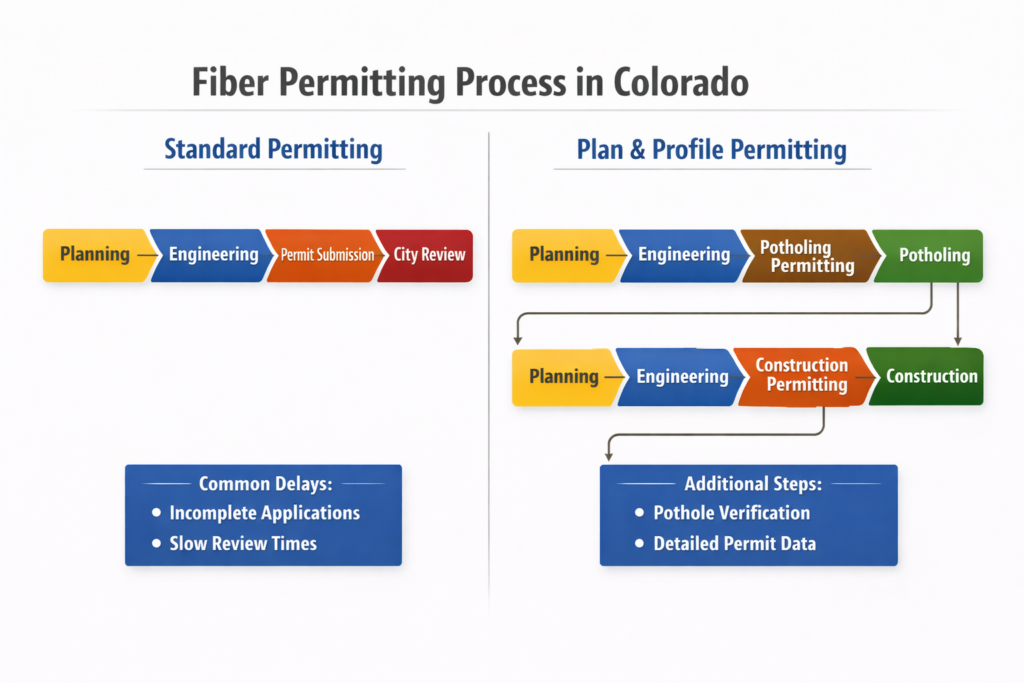
4. Plan and Profile requirements: many municipalities now require Plan and Profile submittals for underground work prior to construction. This is an active requirement for rights-of-way on CDOT roads, as well as in municipalities like Colorado Springs, Douglas County, and Aurora. Plan and profile submittals require two rounds of permitting – first to pothole (to collect data on existing infrastructure) and second to actually conduct the construction (which could be HDD, trenching or plowing).
For network owners, the result is often unexpected project delays that impact budgets, timelines, and customer rollouts.
The Hidden Cost of Outsourced Permitting
Some construction firms outsource permitting to consultants or handle it only after a contract is awarded. While that approach may appear efficient on paper, it can create several real-world problems:
-
Permit applications submitted without full engineering detail
-
Bonding issues that delay approvals
-
Incomplete traffic control plans
-
Slow responses to municipal revisions
Every time a permit package needs revisions, the clock resets. For network owners deploying miles of fiber, those delays compound quickly.
Why Contractors Who Manage Their Own Permits Have an Advantage
When a contractor manages permitting internally, the entire project workflow becomes more coordinated. Instead of waiting for outside consultants, the permitting process is integrated into project planning from the start.
Here’s how that benefits network owners.
1. Faster Permit Turnaround
Experienced permitting teams understand the expectations of local municipalities. They know the typical review cycles, documentation requirements, and common rejection points.
Submitting a complete and accurate permit package the first time significantly reduces approval delays.
2. Established Relationships With Local Municipalities
Contractors who regularly build fiber networks in Colorado develop working relationships with city permitting departments, inspectors, and right-of-way managers.
Those relationships matter. They allow issues to be resolved quickly and help keep projects moving forward.
3. Integrated Project Scheduling
When permitting is handled in-house, it can be coordinated directly with pot holing, engineering, traffic control planning, and construction scheduling.
That means crews aren’t left waiting on approvals while equipment sits idle.
4. Faster Issue Resolution During Construction
Permits don’t stop once construction begins. Plan & profile, field adjustments, traffic plan updates, or restoration requirements can trigger additional approvals.
An internal permitting team can address these changes immediately instead of waiting on third-party coordination.
The Role of Bonding in Municipal Approvals
Many Colorado municipalities (such as City of Lone Tree) require contractors to carry right-of-way bonds or restoration bonds before issuing permits. These bonds protect the city in case infrastructure is damaged or restoration is incomplete (often an issue with “fly by night” contractors who come in from outside of Colorado).
Contractors who manage their own bonding capabilities eliminate another potential delay point.
Instead of scrambling to secure bonding after permits are submitted, the requirements are already in place—allowing applications to move forward without interruption.
Why This Matters for Network Owners
For companies deploying fiber networks, the impact of permitting delays goes far beyond paperwork.
Delays can lead to:
-
Construction schedule disruptions
-
Increased labor and equipment costs
-
Missed service launch timelines
-
Frustrated municipalities and residents
Choosing a contractor with strong permitting capabilities is often one of the most effective ways to protect project timelines.
Fiber Construction in Colorado Requires Local Expertise
Colorado’s regulatory landscape isn’t uniform. A project that runs smoothly in Castle Rock might face entirely different requirements in Lakewood or Fort Collins.
That’s why local knowledge matters.
Contractors who work regularly within Colorado municipalities understand how to navigate city-specific requirements—from traffic control approvals to restoration standards for asphalt, concrete, and landscaping.
This experience helps projects move through approvals faster and reduces surprises once construction begins.
Keeping Fiber Projects on Schedule
As demand for high-speed connectivity continues to grow across Colorado, efficient network deployment has never been more important.
Permitting will always be part of the process—but it shouldn’t become the bottleneck that delays entire builds.
Working with contractors who manage permitting, bonding, and municipal coordination internally gives network owners greater confidence that their projects will stay on schedule from planning through construction. In the commercial construction space, some tech-forward companies (such as Greenlite) are accelerating the speed of permitting.
Ready to Move Your Fiber Project Forward?
If you’re planning a fiber build in Colorado and want a construction partner experienced in municipal permitting, bonding, and right-of-way coordination, Trace Fiber Services can help.
Our team works directly with Colorado municipalities to keep projects moving from engineering through construction.
👉 Contact us to discuss your upcoming fiber deployment:
https://trace-fs.com/contact/